(Use the following links to jump to the associated section in the main data.)

  | Normal List

 
Botanical Name: Tectona grandis L.
Synonyms:
Common Name:
Saj (Arab); Saj, Sal (Pers); Sagun (Hindi); Tekku, tek (Tamil); Teku (Telegu); Jadi, Sagwani, Tega (Kannada); Tekka (Cingh); Kyun (Burma); Djati (Malay).
Classification :
Phylum :  Spermatophyta
Sub Phylum :  Angiospermae
Class :  Magnoliopsida
Order :  Lamiales
Family :  Verbenaceae
Origin:
Indigenous
Distribution:
India, Myanmar, Thailand, Laos, Indonesia, Cambodia, Nepal, Sri Lanka, Bangladesh, Pakistan, Vietnam, Malaysia, Philippines, Papua, New Guinea, Japan, Taiwan, East Africa, West Africa, South Africa, South America and Central America.
Description:
A large deciduous tree. It grows to a height of 60-70 ft. cft and girth of 22 ft. It's size generally varies from locality to locality depending upon the teak favouring quality of the site. The bole is tall, straight, fairly clean, cylindrical and with age moderately fluted and buttressed. Quadrangular and channelled branchlets support very large leaves which are broadly elliptical and obovate with entire margin. White flowers borne in dichotomous cymes of erect terminal panicles produce very hard fruits enveloped in bladder like structure. Bark light brown or grey, fibrous with shallow longitudinal cracks, outer bark peeling off in long thin flakes.
Wood Properties:
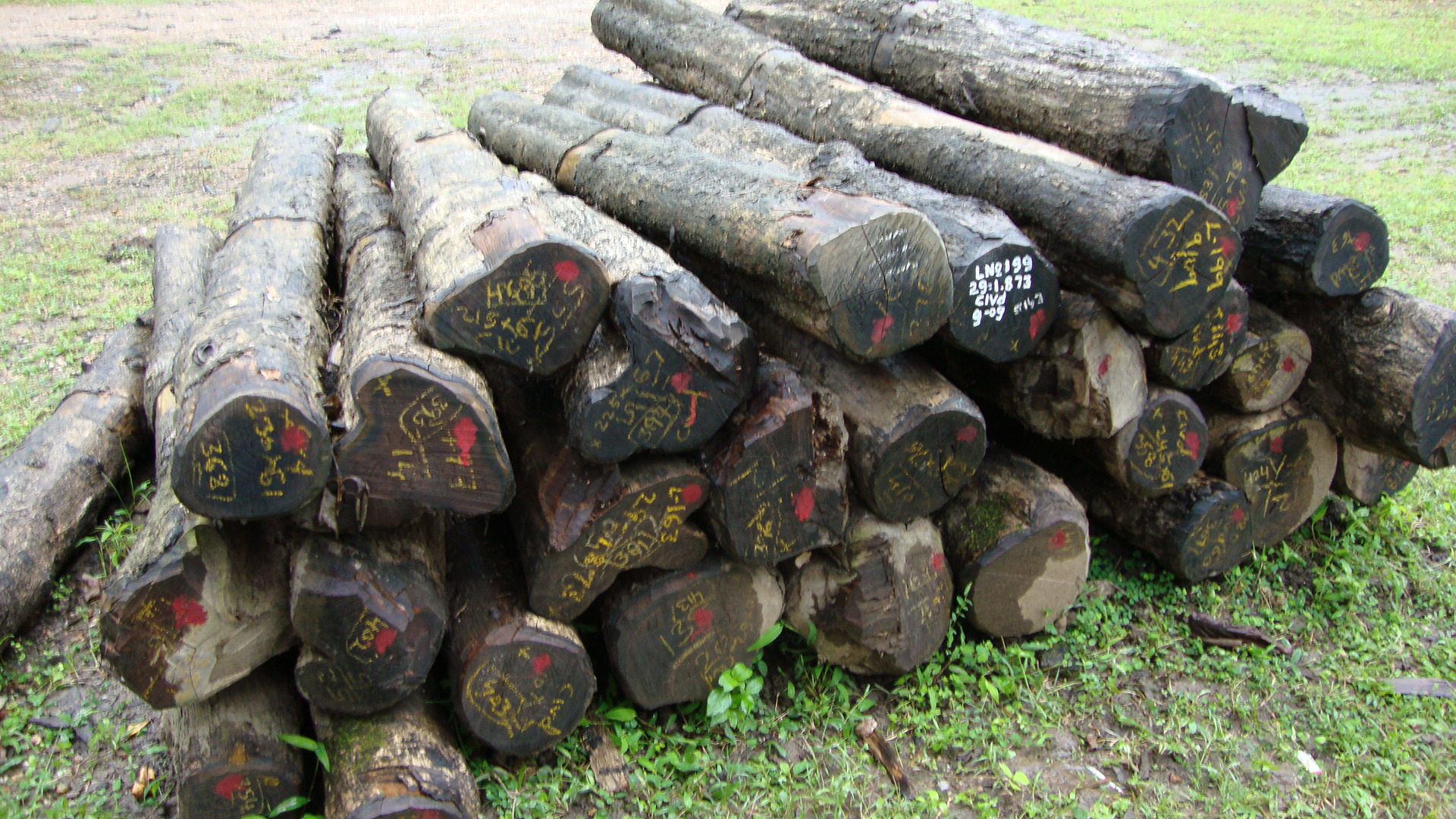
Wood moderately hard, strongly and characteristically scented and containing an oil which is easily perceptible to the touch and is preservative. Sapwood white, usually small; heartwood dark golden yellow, turning brown, dark brown and finally almost black with age. Teak is not felled green, but it is girdle standing, so as to kill it and it is felled and the timber extracted later on. Timber well girdled dries completely and seasons evenly, for it is on all sides freely exposed to sun and wind. Smaller trees dry sufficiently if left standing after girdling for one or two years; larger trees must stand longer. When a teak tree is felled green, that side of the trunk which is in contact with the ground takes a longer time to dry, the timber seasons unevenly. When quite fresh, teak hardly floats, but when seasoned it floats easily and the oil in the wood prevents its getting waterlogged.
Durability:
Extremely durable, resistant to decay, termite and insect attack for very long periods.
Uses:
Various parts of the tree have medicinal uses. Wood is used for consruction work, furniture and cabinet work and the bark is the source of an yellow dye. Wood on distillation yields tar oil which is used in varnish and as a substitute for linseed oil. House building (posts, beams, rafters, paneling, door and window frames, planking, battens, railway etc.) bridge-construction, ship-building, masts, spars, oars, helms, boats, shingles, piles, furniture, cabinet work, carpentry, carving, turnery, well construction, ploughs, yokes, harrows, railway keys, carts, carriages, shafts, axles, spokes, felloes of wheels, solid wheels, looms, frames of spinning wheels, cotton cleaning apparatus, combs, jars, bowls, brush-backs, toys, tobacco-pipes, railway sleepers, railway carriages, wagons, tubs, buckets, barrels, cooperage, double decked platforms, skids, hold fasts, rammer, sponge staves, axle beds of transport carts, planking for wagons, boxes, gun ammunition, small boxes.
Wood Infesting Insects:  ( Click any one Wood Infesting Insect to view details)

1   Ferrisia virgatus Cockerell

2   Odontotermes sp.

3   Araiorrhinus beesoni

4   Tropideres bolinus Jordan

5   Xyleborus sexpinosus Motschoulsky

6   Lyctus africans Lesne

Click  Here.... For more Wood Infesting Insects
Reference:

1  Gamble, J.S. 1972. A Manual of Indian Timbers, Prashant Gahlot at Valley Offset Printers and Publishers, Dehra Dun.526p.
2  Mathur, R.N, Singh,B (1961) Plants in India and the adjacent Countries.Ind.For.Bull.(Ent.)(N.S).No.171(8).
3  The Forestry Compendium. CAB Iernational.http://www.cabicompendium.org/fc/home.asp.
4  Troup,R.S.1986.Indian Woods and their uses , Soni Reprints Agency,Delhi
5  Jha,K.K.(2004.Teak(Tectona grandis) Ecology.Paryavaran Gyan Yagya Samiti Publisher,Lucknow.pp 11.Beeson,C.F.C.1931.The life history and control of Celosterna scabrator Fabr.(Col:Cerambycidae)-Indian For.Rec.(Old series) (Ent.).16(9): 1-16