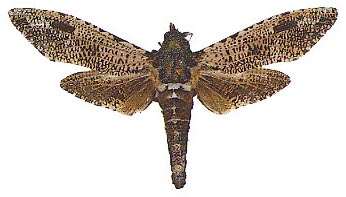
|
|
| Scientific Name: |
|
Zeuzera
coffeae
Nietn.
|
|
| Synonyms: |
|
|
|
|
|
|
|
|
| Distribution: |
| Asia, Bangladesh, Burma, Cambodia, China, India, Indonesia, Laos, Malaysia, Philippines, Sri Lanka, Taiwan, Thailand, Vietnam (North), Australia and Pacific islands, Papua & New Guinea, Irian Jaya. |
| Description: |
| Both wings in the male have the spaces between the veins filled with a regular array of fine but rather weak black striae. In female the striae are more definite, more but do not extend right up to the veins in each space; there is a characteristic large black spot in the forewing cell. In male genitalia the valve has a gentle sub-basal constriction not seen in conferta which has the valve and uncus shorter. |
| Seasonal occurrence: |
| June to July and from October to November. |
| Life Cycle Duration: |
| 4-5 months in south and year in north. |
| |
| Life Cycle Stages: |
| Egg |
| female lays about 500 to 1000 eggs in 1 to 2 Weeks, reddish-yellow eggs are laid in strings on the bark of small stems or branches. |
|
Larva |
| Larvae hatch after 10 days and spin a silken shelter which is easily carried away by wind to longer distances and later settle on suitable host plants and bore into axil of the stem branch. The younger larvae make tunnels, while older ones form irregular cavities and cut circular holes on the outer surface at various distances through which the borer ejects frass. Excrements can be seen adhering to the plant in the form of pellets or fallings to the ground below in a heap, round the plant.Full-grown larva is 40 mm long with a brown head and broad brown curved pronotal shield bearing several rows of small backwardly pointed asperites. The first seven abdominal segments are pinkish above and yellowish below.
|
|
Pupa |
| Before pupation, the larva cuts a circular aperture in the outer wall of the tunnel, which is closed by a thin skin of the bark. Then it spins a loose mesh of silk in the cavity and faces the exit hole. The pupal period lasts for 3 weeks to a month at the end of which it wriggles towards exit hole by pushing the door flap and extending its body half way through the hole. Moth emerges, leaving the empty pupal case protruding from the bark.
|
|
Adult |
| Moth is white with pairs of small black spots on the hind edge of hind wings.
|
| Natural Enemies |
| Phymastichus coffea ( Hymenoptera : Eulophidae). |
| Nature of damage caused |
| Sapling of tree branches and plantations. |
| Control Measures |
| Lopping and burning of infested shoots/ branches. Insertion of thick wire through the bore hole or injecting insecticides like 0.1-0.25 Monocrotophos or 0.2% Paradichlorobenzene in kerosene oil Introducing any fumigant and plugging the borer hole also kills the borer.
For bark caterpillar- spot application of Monocrotophos 0.1% or Fenvalerate 0.08% or Quinalphos 0.1% to drench the bore hole; sleeve the surrounding bark. |
| Host Range ( Click any one Host Range to view details) |
1
Cassia
fistula
L.
2
Tectona
grandis
L.
3
Amherstia
nobilis
Wall
4
Camellia
sinensis
(L.)
O.Ktze.
5
Terminalia
bellirica
(Gaertn.)
Roxb.
6
Vitex
pinnata
L.
|
| References |
|
1
| Mathur, R.N. and Singh, B. Plants In India and the Adjacent Countries.IIndian For.Bull.(Ent.)(N.S).No.171(8). |
|
2
| Coffee Pests, Diseases and Their Management
By J. M. Waller, M. Bigger, R. J. Hillocks |
|
3
| REMADEVI, O.K., AND RAJAMUTHUKRISHNAN, (1998). Incidence, damage potential and biology of wood-borers of Santalum album Linn. Sandal and its Products. Proceedings of an International Seminar held at Bangalore, India. Canberra, ACIAR Proceedings No. 84: 192-195. |
|
|