| Normal List

 
Scientific Name:   Odontotermes obesus (Rambur)
Synonyms:
Odontotermes assamensisHolmgren)O.bengalorensis (Holmgren)  
Classification :
Class  :    Insecta
Order :   Isoptera
Family :   Termitidae
Sub Family    :    null
Origin :   Indigenous
Primary Host :   
Occurrence :   On Living Tree
Distribution:
Andhrapradesh, Jammu and Kashmir, Madhya Pradesh, Karnataka, Maharashtra, Tamil Nadu, Uttarpradesh, West Bengal.
Description:
Seasonal occurrence:
The swarming occurs at during the monsoons and is generally at dusk
Life Cycle Duration:
No information available
 
Life Cycle Stages:
Egg
No information available
Larva
No information available
Pupa
No information available
Adult
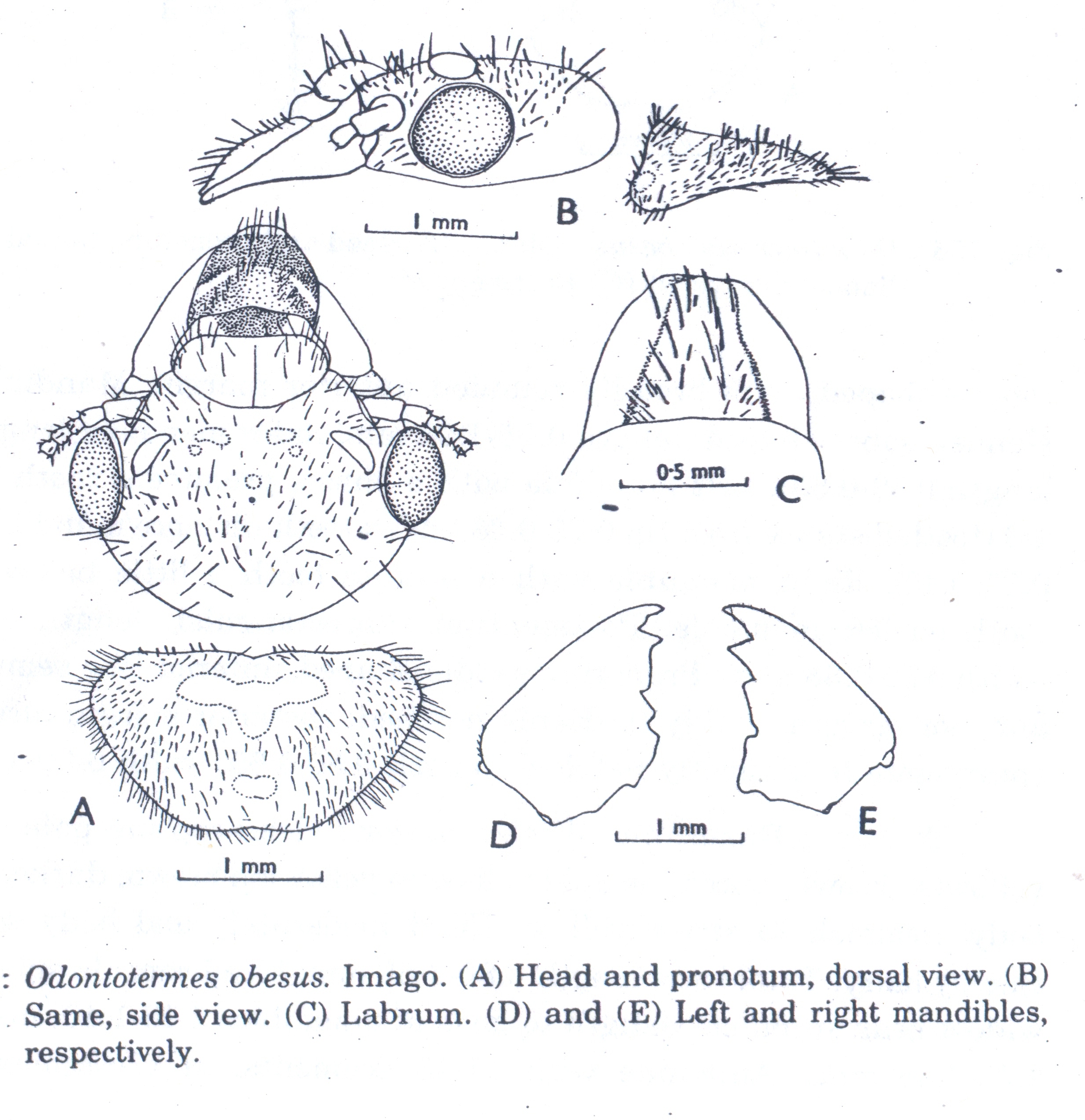
IMAGO: Head-capsule and pronotum reddish brown to castaneous brown; post clypeus reddish brown; wings yellowish brown to somewhat rusty brown. Head and body rather densely hairy. Total body-length with wings 26.0-31.0, without wings 11.0-15.0 mm. Head-capsule sub circular, broader than long (length to base of mandibles 1.85-2.55, max. width with eyes 2.40-2.70 mm). Fontanelle small, ring like, slightly raised. Eyes moderately large and projecting (max. diameter 0.65-0.78, min. diameter 0.53-0.58 mm). Ocelli broad, oval (long diameter 0.30-0.38, short diameter 0.23-0.30 mm); separated from eyes by 1/2 their long diameter (0. 15-0.20mm). Antennae with 19 segments; segment 2 as long as or longer than 3; 3, 4 and 5 variable in size, either 3 or 4 shortest, sometimes 3 and 5 sub equal and shortest. .Postclypeus greatly swollen, hairy; length half or slightly more than half its width. Labrum broad, tongue-shaped with broadly rounded anterior margin. Pronotum subtrapezoidal, with a central, pale, T-shaped mark and two shoulder spots; a little narrower than head (length 1.14-1.48, width 2.28-2.60 mm); anterior margin sinuate, with a weak median notch; posterior. margin sub straight with a weak depression medially. Wings long and narrow; forewing-length 21.4-25.5 mm, hind wing-length 20.5-23.0 mm; radial streak separating from middle of wing membrane; membrane with slightly wavy, thin, cuticular rods SOLDIER: Head-capsule pale yellow to castaneous brown; antennae pale yellow to yellowish brown, darker distally; mandibles light brown to deep reddish brown; body pale yellow to pale brownish. Head sparsely and body moderately hairy. Total body-length 4.0-6.0 mm. Head capsule oval, weakly converging anteriorly (length to base of mandibles 1.03-1.67, max; width 0.95-1.37 mm, index width/length 0.82-0.95 and convergence index Le. width at mandible base/max. width 0.62-0.70). Antennae with 16-17 segments; segment 2 sub equal to 3plus 4 in 16segmented. antennae and 3 in 17 -segmented ones, shortest. Labrum tongue-shaped, with broadly rounded anterior margin. Mandibles long, slender, saber-shaped (length 0.75-1.03 mm, index mandible-length/head length 0.59-0.68). Left mandible with a sharp, prominent tooth at distal 1/3 (tooth-distance from tip 0.25-0.38, index tooth distance/mai1dible-length 0.31-0.40). Right mandible with a minute tooth a little below level of tooth on left mandible. Postmentum sub rectangular (length 0.70-0.93, width 0.50-0.58 mm). Pronotum saddle-shaped, anterior lobe semicircular; anterior margin weakly to deeply notched; posterior margin also weakly emarginate to distinctly notched (length 0.50-0.65, width 0.80-1.07 mm).
Natural Enemies
The most important natural enemies of termites are predators of various kinds, especially ants (Pheidole megacephala (F.), Ochetellus glaber (Mayr)). Winged reproductives emerging on their colonizing flight are eaten in large numbers by lizards, snakes, frogs, insectivorous and omnivorous birds, ants and other predatory insects, especially dragonflies. Workers and soldiers of termites are the diet of the echidna (Tachyglossus aculeatus), burrowing mouse (Oxymycterus roberti), Sloths, Ant bear, numbat, pangolin and other ant eaters such as Myrmecophaga tridactyla, Tamandua tetradactyla, Cyclopes didactylus etc.
Nature of damage caused
No information available
Control Measures
The commonly used preservatives to prevent termite attack on wood are Creosote and Copper Chromium Arsenic (CCA) and also Copper Chromium Boric (CCB). Insecticides like Chlorpyrifos, Permethrin, Cypermethrin and Imidacloprid are also effective in management of wood termites.
Host Range  ( Click any one Host Range to view details)

1      Calophyllum sp.

2      Eucalyptus sp.

3      Garuga pinnata

4      Abies pindrow Royle

5      Shorea robusta Roxb. ex Gaertn.

6      Ficus benghalensis L.

Click  Here.... for some more Host Range

References
1  Holmgren K. and Holmgren N. 1917. Report on collection of termites from India. Mem. Dep. Agric. Indient. Ser., 5(3), pp. 138-171.
2  Sen Sarma, P.K. 1974. Ecology and biogeography of the termites of the India In. Ecology and biogrography in India : 421- 472.
3  Tho, Y. P. 1992. Termites of Peninsular Malaysia.
4  Tho, Y. P. 1974. The termite problem in plantation forestery in peninsular Malasiya. Malayan forester 37 :278 - 283
5  Roonwal, M. L. & O. B. Chhotani. 1989. The Fauna of India and the Adjacent Countries, Isoptera (Termites) Volume I. Zoological Survey of India, Calcutta.
6  Holmgren, N. 1912. Termites from British India (Bombay) collected by Dr.J. Assmuth. J. Bombay nat. Hist. Soc., 21(3): 774-793, 4 pls.
7  Indradev, Rajiv Pandey and Chauhan, K.S. (2001). Natural durability of commercially important timbers and efficacy of preservatives on land (Part-A). Journal of T.D.A. 47 (1 and 2): 27-33.
8  Mohd. Dahlan Jantan and Tam Mun Kwong. (1985). Natural durability of some Malaysian timbers by stake tests. The Malaysian Forester; 48 (2):154-159.
9  Snyder, T. E. 1956. Annotated, Subject-Heading Bibliography of Termites, 1350 B.C. to 1954 A.D. Smithsonian Miscellaneous Collections, Volume 130.
10  L. G. Kirton, editor. Maylasian Forest Records No. 36, Forest Research Institute Malaysia, Kuala Lumpur.
11  Holmgren, N. 1913a.Termites from British India (near Bombay IN Gujarat and Bangalore) collected by Dr.J. Assmuth. J. Bombay nat. Hist. Soc., 22 (1): 101-117. 3 pls.
12  Roonwal, M. L. & P. K. Sen-Sarma. 1960. Contributions to the Systematics of Oriental Termites. Indian Council of Agricultural Research, New Delhi.
13  Holmgren, N. 1911. Bemerkugen uber einige Termiten-Arten.Zool.Anz, 37(26): 545-553.
14  Krishna, K, & F. M. Weesner. 1969, 1970. Biology of Termites, Volumes I & II Academic Press, New York.
15  Rattanlal and Menon, R. D. 1953. Catalogue of Indian Insect. Part 27- Isoptera. 94 pp.(Govt. of India Publ.)
16  Bose, G. 1984. Termite Fauna of Southern India. Misallenious punication 47. Records of the Zoological Survey of India, 49: 1-270.
17  Krishna, K, & F. M. Weesner. 1969, 1970. Biology of Termites, Volumes I & II. Academic Press, New York.
18  Walcott, R. S. 1946. Factors in the natural resistance of wood to termites attack. Caribbean forest. 7:121-134.
19  Whittaker, R. S.1970. The biochemical ecology of higher plants. In chemical Ecology eds Sondheimer and J. B. Simeone, Academic press, PP. 43-70.
20  Termites and Termite Control. University of California Press, Berkeley. Konig, J. G. 1779.
21  Chhotani, O. B. 1997. Fauna of India - Isoptera (Termites). Vol. II. Zoological Survey of India, Calcutta. 20 801.
22  Ahmad, M. 1950. The Phylogeny of the Termite Genera Based on Image-Worker Mandibles. Bulletin of the American Musem of Natural History, 59: 40-86.
23  Scheffrahn, R. H. and Su .N. Y. 1990. Economically important termites in the United States and their control. Sociology, 17: 77-94.
24  Snyder, T. E. 1966. Second Supplement to the Annotated, Subject-Heading Bibliography of Termites, 1961 to 1965. Smithsonian Miscellaneous Collections, Volume 152, No 3.
25  Abe, T., N. Kirtibutr, & J. A. Holt. 1995-1997. Global diversification of termites- Its pattern and causal mechanism. Intl. Sci. Research of the Japanese Ministry of Education, Science, Sports and Culture. (Project No. 07044193).
26  Snyder, T. E. 1961. Supplement to the Annotated, Subject-Heading Bibliography of Termites, 1955 to 1960. Smithsonian Miscellaneous Collections, Volume 143, No3.
27  Walcott, G. N. 1957 Inherent natural resistance of wood to the attack of the West Indian dry wood termite Cryptotermes brevis Walker. J. Agric. Univ. Ryukus 25:555-613.
28  Sen Sarma, P.K., Thakur, M.L., Misra, S.C. and Gupta, B.K. (1975). Wood destroying termites of India; F.R.I. Publication.
29  Vinson, S. B., editor. 1986. Economic Impact and Control of Social Insects. Praeger, New York.